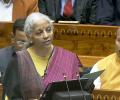
Budget 2026 sticks to fiscal discipline, shuns populist measures despite five key state elections coming up, but ends up rattling stock markets with a higher transaction tax on derivatives trading.

Around 30-50 million passengers in the reserved category have switched over to digital payments.

The number of cyberfraud cases has skyrocketed from 2,677 in 1999-2000 to 29,082 in FY24 -- more than a 10-fold increase. The RBI pegs digital payment frauds at Rs 1,457 crore in FY24, up more than five times in a year. It's not just the number of frauds. What's alarming is the growing sophistication of the fraudsters, exposing the vulnerabilities within the financial system, observes Tamal Bandyopadhyay.

The move would help tax authorities get leads on evasion.

Competition Commission of India (CCI) on Monday granted its approval for the acquisition of 100 per cent equity of indiaideas.com (BillDesk) by PayU Payments. The proposed combination relates to the acquisition of 100 per cent of the equity share capital of India Ideas Ltd (IIL) by PayU India. In a tweet on Monday, CCI said it approved, "acquisition of 100% of the equity share capital of IndiaIdeas.com (BillDesk) by PayU Payments."

Former IPS officer Amar Singh Chahal allegedly shot himself after claiming he was duped of Rs 8.10 crore by cyber thugs. He was one of the accused in the 2015 police firing cases related to anti-sacrilege protests in Faridkot.

PhonePe wants to dethrone its Alibaba and SoftBank-backed rival, Paytm, claiming that additional capital that Walmart will bring to the table will help it grow much faster

President Droupadi Murmu has given her assent to the Viksit Bharat Guarantee for Rozgar and Ajeevika Mission (Gramin) Bill, which aims to replace MGNREGA and guarantee 125 days of wage employment per rural household.

Reserve Bank of India (RBI) Governor Sanjay Malhotra on Wednesday said regulations should not create unintended barriers to financial inclusion while emphasising that the impact of regulations on individuals and businesses should be considered.

'Dear Business Partner, Kindly note and inform your all customers that Digital Cashback has been revised from 0.75 per cent to 0.25 per cent with effect from August 1, 2018 across oil industry for all loyalty customers,' said the text message sent by State-owned oil companies to petrol pump operators.

After Yes Bank was placed under moratorium, digital payments were impacted as PhonePe, which depends on the cash-strapped lender for its transactions, could not operate. Even the bank's own net banking facilities have not been operational since last evening. Other fintech operators who rely on Yes Bank to settle their transactions are also down.

'This marks a turning point for Paytm, with the regulatory environment looking much clearer than it has been in the last two years.'

After two years of strong gains, smallcap stocks fell sharply in 2025, but the correction may be setting up opportunities for long-term investors.

The Bharat Interface For Money app was launched on the iOS platform earlier this month. It is also available on the more popular Android platform. There have been over 17 million downloads of the BHIM app so far.

'Other sectors that manage the savings pools of Indians are giving tough competition to life insurance companies.'

Cyber fraudsters have duped Delhi residents of nearly Rs 1,000 crore so far this year, with investment scams, digital arrests and boss scams emerging as the most common cybercrimes.

An hour-long disruption could affect around 40 million UPI transactions.

Digital payment solutions provider Paypal on Friday said it will stop offering domestic payment services within India from April 1.

Delhi Police have invoked Section 356 of the Bharatiya Nagarik Suraksha Sanhita for the first time, allowing the trial of an absconding accused in a murder case to proceed.

BHIM is a platform designed to make payment through UPI and USSD modes simpler.

'The first time India has seen two consecutive blockbuster IPO years.'

The Centre on Sunday said there are no plans to levy charges for making payments through Unified Payments Interface (UPI) while saying the service is a "digital public good with immense convenience". The ministry of finance said the concerns of service providers for cost recovery have to be met through other means. "UPI is a digital public good with immense convenience for the public & productivity gains for the economy.

Gujarat police arrest a woman allegedly involved in trafficking job aspirants to Myanmar and Thailand for cyber slavery. The accused lured people with promises of high-paying jobs and forced them to work for international cyber crime syndicates.
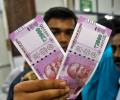
Amazon customers can now use their Rs 2,000 notes to top up their Amazon Pay balances during cash-on-delivery orders, as it offers a doorstep solution to ease the stress of exchanging such currency. Customers can deposit cash of up to Rs 50,000 per month, including notes of Rs 2,000 denomination, Amazon said. The cash load at doorstep service by Amazon Pay is helping consumers convert high-value notes for digital transactions.

Concerned over the rise in mis-selling of products by banks and non-banking financial companies (NBFCs), the Reserve Bank of India (RBI) is examining whether to come up with norms to curb such practices. Observing that pushing financial products, such as insurance, indiscriminately to unaware consumers may be detrimental to their well-being, RBI Deputy Governor M Rajeshwar Rao said, "We are examining whether it necessitates framing of guidelines to address mis-selling of financial products and services by REs (regulated entities)."

Digital transaction players are hurriedly drawing up a memorandum to be taken to the central bank in hope of having a few of the guidelines -- such as full Know Your Customer (KYC) compliance in 12 months -- overturned, reports Karan Choudhury

'I will not be surprised if there is a 7 per cent handle in front of the decimal place for the full financial year.'

'The real story of 2025 is that India officially stopped being a 'market of the future' and started acting as the world's primary economic engine.'

The Employees' Provident Fund Organisation (EPFO) board has approved liberalised part withdrawals for subscribers, allowing up to 100 per cent EPF withdrawal, and rolled out the 'Vishwas Scheme' to reduce litigation through rationalised penal damages.

Reserve Bank of India (RBI) on Friday permitted banks and non-banking institutions to issue pre-paid instruments for making payments across various public transport systems. With the introduction of these instruments, commuters will have more options to pay for tickets besides cash mode.

Digital services work best when the seller designs a system where default options are designed to help the buyer, says Debashis Basu.

A 32-year-old Delhi resident was allegedly duped of over Rs 9 lakh by a person posing as the chief of the Anti-Terrorism Squad (ATS) and accusing him of being involved in the Pulwama terror attack.

The IPO wave of 2025 is here, and it's bigger than ever. From fintech unicorns to financial powerhouses and infrastructure giants, some of India's biggest names are all set to make their stock market debut. PhonePe, Zepto, Tata Capital, NSE, NSDL, and JSW Cement are just a few of the highly awaited listings that have investors and analysts buzzing with excitement.

To handle the sudden loss of cashless facility, patients should maintain an emergency fund or a short-term credit line to manage all or part of hospitalisation costs.

The Federation of Indian Chambers of Commerce and Industry (Ficci) has sought urgent steps to clear the huge backlog of income-tax appeals, simplify tax deducted at source (TDS) compliance, and ensure tax neutrality for fast-track demergers, during its consultation with Revenue Secretary Arvind Shrivastava ahead of the Union Budget 2026-27.

'Traders must adopt digital payments as soon as possible within a set timeframe, as the nation is moving rapidly towards digitisation.' 'Ignoring digital systems is not an option for strengthening trade.'

Currently, only three have completed more than six months of operation in the space - Fino Payments Bank, Airtel Payments Bank and Paytm

Messaging platform WhatsApp on Wednesday said it has rolled out a pilot program across 500 villages across Karnataka and Maharashtra, aimed at empowering villagers with access to digital payments through 'payments on WhatsApp'. The announcement was made at Fuel For India 2021 - Meta's annual event in India. WhatsApp India Head Abhijit Bose said the pilot aims to effect a behavioral transformation to digital payments at the grassroots.

Telecom firm Bharti Airtel will approach the government on the adjusted gross revenue (AGR) it has to pay the exchequer following the Supreme Court's judgment that the government can reassess all AGR dues, according to vice-chairman and managing director Gopal Vittal.

Amazon will invest more than Rs 2,000 crore (about $233 million) in India in 2025 as it strengthens its logistics and safety standards, said the ecommerce company on Thursday.
